Posts

"Tissues" PART-1 (Plant Tissues)

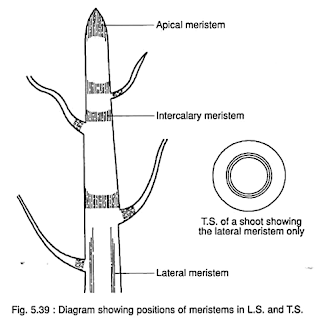
TISSUES PART 1 (PLANTS TISSUES) Notes by:- Nagraj Sir Tissue :   A group of cells, that are similar in structure and work together to achieve a particular function, forms a tissue. they are two types 1-meristematic 2-Permanent Meristematic tissue :   Meristematic tissues are the tissues which have the ability to grow by rapid division.  They help in the primary growth of the plant. These cells are closely packed with no intercellular spaces. they are 3 types 1-APICAL 2-LATERAL 3- INTERCALARY     •  Apical meristem is present at the apical or growing tips of stems and roots.  Apical meristem increases the length of the plant.     •  Lateral meristem is present in the radial portion of the stem or root.  Lateral meristem increases the girth of the plant.     •  Intercalary meristem occurs at the base of the leaves or at the internodes.  Intercalary meristem increases the length of ...
ALL DIAGRAM OF CHAPTER TISSUES by Nagraj Sir

Image
ALL DIAGRAM OF CHAPTER TISSUES by:- Nagraj Sir Plant Tissues A.Meristematic tissues apical , lateral , intercalary B.permanent tissues 1 simple parenchyma 2.collenchyma 3.sclerenchyma C.complex xylem and phloem Animal tissues A.epithelium 1.squamous 2.cuboidal 3.columnar. 4.ciliated 5.glandular B.muscular tissues C.connective tissues 1.areolar 2.adipose 3.skeletal 4.dense regular connective tissues tendon and ligament fluid tissue blood and lymph D.Nervous tissues

"TISSUES" PART 2 (ANIMAL TISSUES)

Image
TISSUES PART 2 (ANIMAL TISSUES) Notes by:- Nagraj Sir Animal Tissues are divided on the basis of function are four types:- A.Epithelial Tissue B. Muscular Tissue C. Connective Tissue D.Nervous Tissue A.Epithelial Tissue: the epithelial tissues are classified as follows: Squamous epithelium Cuboidal epithelium Columnar epithelium Glandular epithelium Ciliated epithelium Differences between different types of epithelial tissues: S. No. Characteristic property Squamous epithelium Cuboidal epithelium Columnar or glandular epithelium Ciliated epithelium   Shape of cells It consists of thin, flat. Disc like polygonal or irregular-shaped cells with round and flat nucleus. It consists of cube-like cells of almost equal height and width. It consists of tall, cylindrical, pillar-like cells. Basal part of cell bears oval nucleus It consists of tall cells with cytoplasmic hair like cilia at free ends.   Appearance of cells Adjacent cells fit together like til...

Class-IX ..Chapter-CELL by :- Nagraj Sir

Cell Notes by:- Nagraj Sir                            Cell : -it is called the fundamental unit of life. It is capable of independent existence and can carry out all the functions which are necessary for a living being. A cell carries out nutrition, respiration, excretion, transportation and reproduction; the way an individual organism does. Due to this, a cell is called the fundamental and structural unit of life. All living beings are composed of the basic unit of life, i.e. cell.                                                                                  HISTORY OF DISCOVERY OF C...