Posts

Notes on Improvement in Food Resources by Nagraj Sir

Notes on Improvement in Food Resources by Nagraj Sir Introduction All living organisms essentially require the food to stay alive. Food provides energy to perform various life activities and is required for growth, development and body repair. Sources of Food : 1. Food from agriculture: Cereals, pulses, vegetables, fruits, nuts, oilseeds, condiments and spices 2. Food from animal husbandry: Dairly products like milk, curd, butter; meat, egg, fish and other sea products.   Kharif crops : The crops grown in rainy season are called as Kharif crops (Paddy, Soya bean, pigeon pea and maize). They are grown from June to October. Rabi crops : The crops grown in winter season are called  Rabi crops  (Wheat, gram, peas, and mustard). They are grown November to April. Food Revolutions in India With the increase in population, there needed a sufficient increase in food production, so as to meet the food related demands of growing population. This led to the rise...
"Tissues" PART-1 (Plant Tissues)

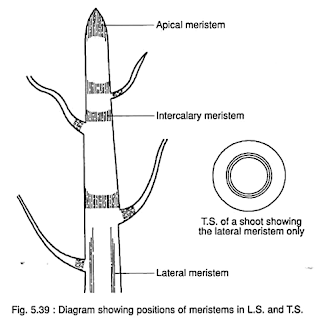
TISSUES PART 1 (PLANTS TISSUES) Notes by:- Nagraj Sir Tissue :   A group of cells, that are similar in structure and work together to achieve a particular function, forms a tissue. they are two types 1-meristematic 2-Permanent Meristematic tissue :   Meristematic tissues are the tissues which have the ability to grow by rapid division.  They help in the primary growth of the plant. These cells are closely packed with no intercellular spaces. they are 3 types 1-APICAL 2-LATERAL 3- INTERCALARY     •  Apical meristem is present at the apical or growing tips of stems and roots.  Apical meristem increases the length of the plant.     •  Lateral meristem is present in the radial portion of the stem or root.  Lateral meristem increases the girth of the plant.     •  Intercalary meristem occurs at the base of the leaves or at the internodes.  Intercalary meristem increases the length of ...

ALL DIAGRAM OF CHAPTER TISSUES by Nagraj Sir

Image
ALL DIAGRAM OF CHAPTER TISSUES by:- Nagraj Sir Plant Tissues A.Meristematic tissues apical , lateral , intercalary B.permanent tissues 1 simple parenchyma 2.collenchyma 3.sclerenchyma C.complex xylem and phloem Animal tissues A.epithelium 1.squamous 2.cuboidal 3.columnar. 4.ciliated 5.glandular B.muscular tissues C.connective tissues 1.areolar 2.adipose 3.skeletal 4.dense regular connective tissues tendon and ligament fluid tissue blood and lymph D.Nervous tissues

"TISSUES" PART 2 (ANIMAL TISSUES)

Image
TISSUES PART 2 (ANIMAL TISSUES) Notes by:- Nagraj Sir Animal Tissues are divided on the basis of function are four types:- A.Epithelial Tissue B. Muscular Tissue C. Connective Tissue D.Nervous Tissue A.Epithelial Tissue: the epithelial tissues are classified as follows: Squamous epithelium Cuboidal epithelium Columnar epithelium Glandular epithelium Ciliated epithelium Differences between different types of epithelial tissues: S. No. Characteristic property Squamous epithelium Cuboidal epithelium Columnar or glandular epithelium Ciliated epithelium   Shape of cells It consists of thin, flat. Disc like polygonal or irregular-shaped cells with round and flat nucleus. It consists of cube-like cells of almost equal height and width. It consists of tall, cylindrical, pillar-like cells. Basal part of cell bears oval nucleus It consists of tall cells with cytoplasmic hair like cilia at free ends.   Appearance of cells Adjacent cells fit together like til...